
STP Vs. RSTP – Answer 1
The first STP vs RSTP question in the series asked only about STP, as a way to get you thinking about the features in common between STP and RSTP. Today’s post gives the list of correct answers, plus makes a few points about which answers should be obvious without giving the answer a lot of thought. The next question will then dive into some RSTP options!
Related posts:
- STP Vs. RSTP Question 1
- STP Puzzles
- Overview of how to approach STP puzzles
- Link to the ICND2 book (to learn more STP)
General Advice
Before listing the answers, let me summarize a few key points that can let you quickly rule out some of the answers as incorrect.
Ruling Out Port Roles that do NOT Apply to STP
One key difference between RSTP and STP relates to two port roles added by RSTP: the alternate port and backup port role. STP simply does not include these port roles. So, knowing this fact, any of the answers that list “STP” as the protocol, and either alternate port or backup port as the port role, cannot possibly be true.
Root switches Cannot have Root Ports
Both STP and RSTP use the same logic of choosing one switch to be the root switch. Then, both STP and RSTP have each non-root switch determine its port that’s part of the best path back towards the root switch. That port is that switch’s root port.
As a side effect of the above rules, one switch – the root switch – does not have a root port. So, any question that identifies the root switch cannot then claim a root port exists on that switch!
Correct and Incorrect Answers
STP, SW1, G0/1, Root Port – Incorrect. SW1 is the root switch, so it cannot have a root port.
STP, SW1, G0/2, Backup Port – Incorrect. The protocol is STP, and STP does not have a Backup port role.
STP, SW2, G0/2, Designated Port – Incorrect. This is actually a pretty interesting case for STP and RSTP. With SW1 as the root switch, it will advertise a root cost of 0 on the link between SW1 and SW2. Even if SW2’s root port is SW2’s G0/1, SW2’s root cost will be larger/worse than SW1’s root cost, because SW1 is the root switch. So, there is no possibility that SW2’s G0/2, which connects directly to the root switch, to become a designated port.
STP, SW2, G0/1, Alternate Port – Incorrect. The protocol is STP, and STP does not have an Alternate port role.
STP, SW3, G0/1, Root Port – Correct. With default configuration, this port will be part of SW3’s least cost path to reach the root switch (SW1).
STP, SW3, G0/2, Backup Port – Incorrect. The protocol is STP, and STP does not have a Backup port role.
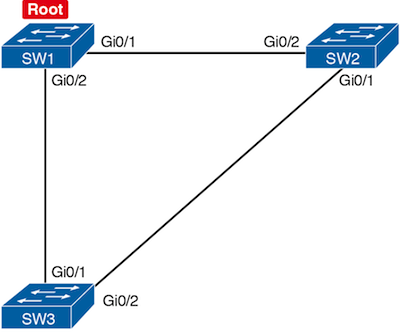
Figure 1